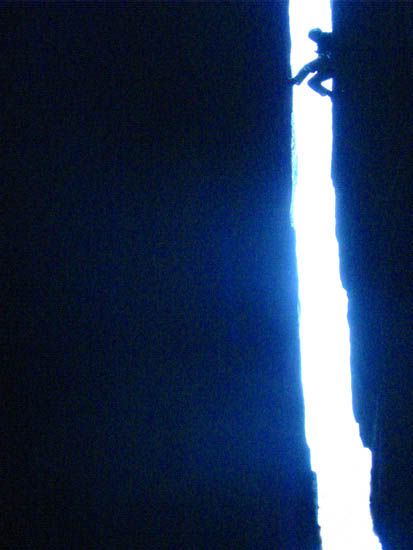
When I began rock climbing in 2004, it was as if I had found something I'd been searching for my entire life. The level of consciousness necessary to unlock the vertical puzzles I encountered on each route was intense. As I succeeded, whether it was in making a single transitional move or climbing the line cleanly with no falls, my self-esteem level rose and I became more confident in my abilities and in feeling my place in the world.
Soon enough, I was meeting others who share my passion, and visiting climbing destinations around the United States. On one of those early trips, my partner and I thrashed our way through terrain on a steep mountainside- bushwacking, as it is called when there is no established path. I was pretty nervous, as I had never even really
been on a mountain before, much less one that appeared, to my untrained eyes, to have never seen foot traffic before.
My friend told me we actually "were" on a trail, and showed me the vaguest of clues to support his statement. I had to take his word for it, but a few days later we went back along the route and he explained some basic techniques in what as known as "trailbuilding."
As I helped push the leaves and twigs that carpeted the wooded floor downslope, I was amazed at how simply a path had become clear. Further, we added fallen branches along the lower edge, which would allow for a buildup of support to the slope as the leaf litter recycled itself in nature's perpetual transition. Our path meandered down the steep mountainside, switchbacking side to side, until it ended at an exposed cliff edge.
It was no dead end, however, for there was an ancient old tree, from which we would rappel a hundred or more feet to the valley below. The tree was equipped with a "rap station," a group of several wide nylon webbings, slung around the tree a few feet up from the roots, where it had split off at a young age to create three distinct trunks. The webbing ran through heavy steel rings, which we would in turn thread our rope. Attaching ourselves with devices for the purpose, we would slowly slide down the rope to reach the bottom of the cliff we were there to climb.
He explained to me how the area was one that was being "developed," a term rock climbers use for crags where they are making the first ascents of climbs on the rock walls. Soon, more people would be walking through the woods as we had, as they learned the area had some interesting routes to try. By creating one path, designed to reduce erosion on the hillside, we would be assisting visitors in finding their way, but much more importantly, we'd be helping the natural environment to withstand the impact of our presence.
This made sense, of course, but with that moment came an awareness; a realization that
all the trails I'd
ever followed, in all my years, had been designed, created and cared for by people, just as the two of us were doing at that moment. Whether it had been a hiking path up a hill in the Adirondacks that would accommodate school groups, or a newly blazed single-file trail like the one I was helping create down in Georgia, I sensed a connection to everyone who had ever traveled that way before, and all those who would come through in the future.
The reality was, that it was hard work, too. Hauling heavy branches, moving big rocks, digging trenches to set those rocks into as a reinforcement to the slope. All this effort served to focus my energy, and with that focus came yet another awareness - my connection to the land. Not only the earth, but other living things that shared it with me; insects, plants and animals.
Though I only worked for parts of two or three days on that initial project, my world was forever changed, and as I hiked along the ridge or cliffbase back home in the Shawangunks, I began to take notice of the similarities and differences between these trails and the one I described above. I wondered who had been responsible for their creation, and one day - I got an answer.
I was out for a day of climbing in the Near Trapps and saw two men approaching on the trail. They had one tool that I recognized, and others that confused me. But I knew their purpose - to work on the trail! As the men came by us, I said "Off for some trailwork, eh?" To which, of course, they replied in the affirmative. They said they were going to repair an are of the trail a little ways down, and that by the time we finished our climb they might be done. "Come down and try it out!" one of the men invited.
After our climb, we did head that way, and came upon them just as they were finishing up their small project. I was invited, again, to take the first step on this new section, and as I did, the man said "You're the first person to use that step; how does it feel to you?"
I said it was very nice and mentioned that I was actually interested in trailwork, and wondered how I might get involved. "Who would I contact?" I asked. The man said "Well - that would be me, actually."
He wrote his email address on a slip of paper, folded it into a neat square and handed it to me. "Send me an email, and I'll add your name to our list. We usually work on Sundays and I'll send you a notice for our next day of work." With that, I thanked him and placed the paper in a zip pocket of my backpack for safe keeping.
After a good day of climbing, my partner and I headed into New Paltz for a delicious dinner at Bacchus, which is a local climber's hangout. We noticed a group of other climbers with whom I was familiar and they invited us to join them. As conversation drifted in and out with stories of our day's adventures, my turn came and I mentioned the story of the trail work men, and how I had asked to join the crew.
When I relayed the bit about the guy saying he was the crew leader, my friend exclaimed "YOU met Dick Williams!?"
I was a newish climber, but not THAT new. I was well aware that Mr. Williams was a well-known climber who had done many first ascents in the area, and that he was also the author of the guidebook in my pack. What I hadn't known was that it was he I had been speaking with earlier that day, and I was actually very glad. I would have been giddy with excitement and unsure of what to say, and I know darned well I would have fawned over him and made a stupid comment about - if you are a climber, you know what - that famous photo on Shockley's Ceiling, where Williams is climbing in the buff and the only "coverage" is a strategically lifted leg and a sling of pitons and carabiners. Luckily, I was spared that embarrassment!
Still, I wasn't sure of whom I had met, since I hadn't looked at the email address before stowing it. I'd moved it to my personal wallet before coming into town, so I would have it handy at home when I next used the computer, and so I pulled it out and took a look. Sure enough, it had been he, and for a very short moment, I was the star of the table in Bacchus that night.
And so it came to be, that my name was added to the trail crew mailing list. A few weeks later, I was able to make myself available to join in and anxiously awaited the day, wondering what to expect.
Imagine my surprise to discover..... I was the only female in the group. And not only that, I was amongst some very able-bodied guys who knew how to dig in and do hard work. I felt very awkward at first, and foolish. Not only was I unable to lift the hundred-plus pound stones these guys were maneuvering, but I didn't have work gloves and my shoes were...flip flops. Not only that, I had absolutely no idea as to how to make myself useful. I was, I felt, going to be in the way.
And.... I was.
At least, at first. I simply couldn't do the work some of these guys were doing, and didn't know what else to do. I shifted my position, on the ready to grab a big rock if need be, but of course I wasn't needed.
Finally, a row of rocks had been planted along the sloping ridge, to hold the path in place. I saw the gaping spaces that needed filling on, and began to grab handfuls of dirt to do it.
The others kept moving along the trail, maneuvering boulders into place with a grip hoist and rock bars(mechanical tools used to move rocks to large to do so with one's body alone). I continued on my little project, filling in the gaps afterward.
At one point, a rock was being difficult and I heard one of the men call "Where's that bar?" In a flash, I was up and at it, grabbing the rock bar and bringing it over.
I had found my place in the system!
As I became familiar with the work to be done, I realized that often the tools were left along the work zone after being used, and began to anticipate when they'd be needed again. Soon, nobody had to wonder where a tool was - I would hand it to them as they were about to say they needed it.
My "finishing work" - filling in after the rock reinforcements were placed - became known as the "beautification committee," and though at first I thought I was just doing make-do work, I did come to understand that this bit of work was actually needed and part of completing the project.
I took pride in being able to facilitate the other, stronger, people on the crew, even if my efforts were substantially less strenuous. And then...one day.... we were short volunteers. There was heavy work to be done, and someone had to do it. I stepped up to plate and...did the best I could.
While I will never be able to budge a two-hundred pound boulder, nor crank half a day on a grip hoist under full load, I did begin to take on those aspects of the work, and found great pleasure in the hard, manual labor. Especially at day's end, when reviewing our progress from the start. And even more so days and weeks later, when I traveled the finished sections, knowing that my efforts had helped in this conservation work.
I began to show up each Sunday, and I looked forward to it. As volunteers came and went, I found that often I was one of the people who actually knew what needed being done, and often helped new recruits learn the systems. In 2006, my first full season of heavy involvement, I cajoled partners and others into volunteering and brought five people on board to help throughout the season.
People would ask me to climb on Sundays and I had to turn them down, as I was committed to trailwork. At first, my friends didn't understand, and wondered what harm it would do to miss "just this one day." After all...they needed a partner, and I can assure you that, if I was the one they were trying to convince...that they really
needed a partner. I may be a diligent belayer, but I am no hard woman. There are plenty of others who climb much higher grades than I do.
Soon, I began to meet other climbers - the ones that were "of note" in the area. They'd stop to talk with Dick, and we'd all get in on the conversations. I heard wild stories from back in the day, interesting adventures they'd just returned from from, and of plans they were about to pursue. Among my younger, less experienced, group of climbers - I
knew stuff that I wouldn't have otherwise. Walking down the carriage road, these well-known climbers would acknowledge me, and afterward my partner would ask, increduously, "Do you
know who that was?"
As my commitment to trailwork grew, I found, much to my surprise, that I had moved to New Paltz. This came as big news to me, since I was fairly certain that I still lived in New York City. But after the fifth or sixth person made some comment about my being a local, I asked for clarification. What I found was that people were saying the reason I was able to do trailwork each Sunday must be that I had moved to the area and was climbing during the week. What other explanation could there be for someone to give up a whole day of climbing?
Each week we would work hard, moving boulders in sizes ranging from picnic coolers to mini fridges, using griphoists, rock bars and sometimes brute force. Other ways we work to improve the access trails are to remove "ankle-breaker" stones that rise from the ground at cliff base when they are below routes known for difficult starts, widen sections to allow a litter to be passed in event of a rescue, and rearrange and stabilize boulders on marked trails through talus fields. One day we hauled a 30 to 40 foot long, 3 foot wide, tree trunk up the talus slope to use as a retaining barrier. It took a team of six people more than five hours of solid effort, but every time I pass by the Snooky's Revenge climb, I am reminded of the teamwork involved, and the fact that this tree will not only slow erosion on the slope but provide a perfect place for people to sit and slip into their climbing boots, ready to climb another day.
This is work that helps the cliffside environment to withstand the impact our presence causes. With no precautions, the exposed roots on old trees and fragile bushes would be trampled as people pass by, lessening their lifespan. Their root systems play an important part in conserving the slope, and of course, the roots are life support for the trees in the first place. Those trees provide not only homes for birds, bugs and other animals native to the area, but shade for delicate plants below that could not live without the protection. Not only that - we people appreciate the shade too! But back to nature, the habitat is an interdependent system, and when one part suffers, it affects the whole.
Working together towards this goal of sustaining the land, we develop relations within out own habitat as well. People pass by and stop to chat, and soon we know another member of our community. We'll see them elsewhere, maybe on the cliffs, maybe in town or even across the country. I've run into more than a few people in Joshua Tree who remember me from having passed by while I was doing trailwork, and the opposite is true, too. I'll be working along the cliffside and someone stops, surprised - we had camped next to each other near a crag a thousand miles away the year previous. It's a small world, after all.
 Subscribe in a reader


 Posts
Posts